The Uncanny: Hamlet as a Psychoanalytic Tragedy
Roxana Grunenwald
Zara Belo
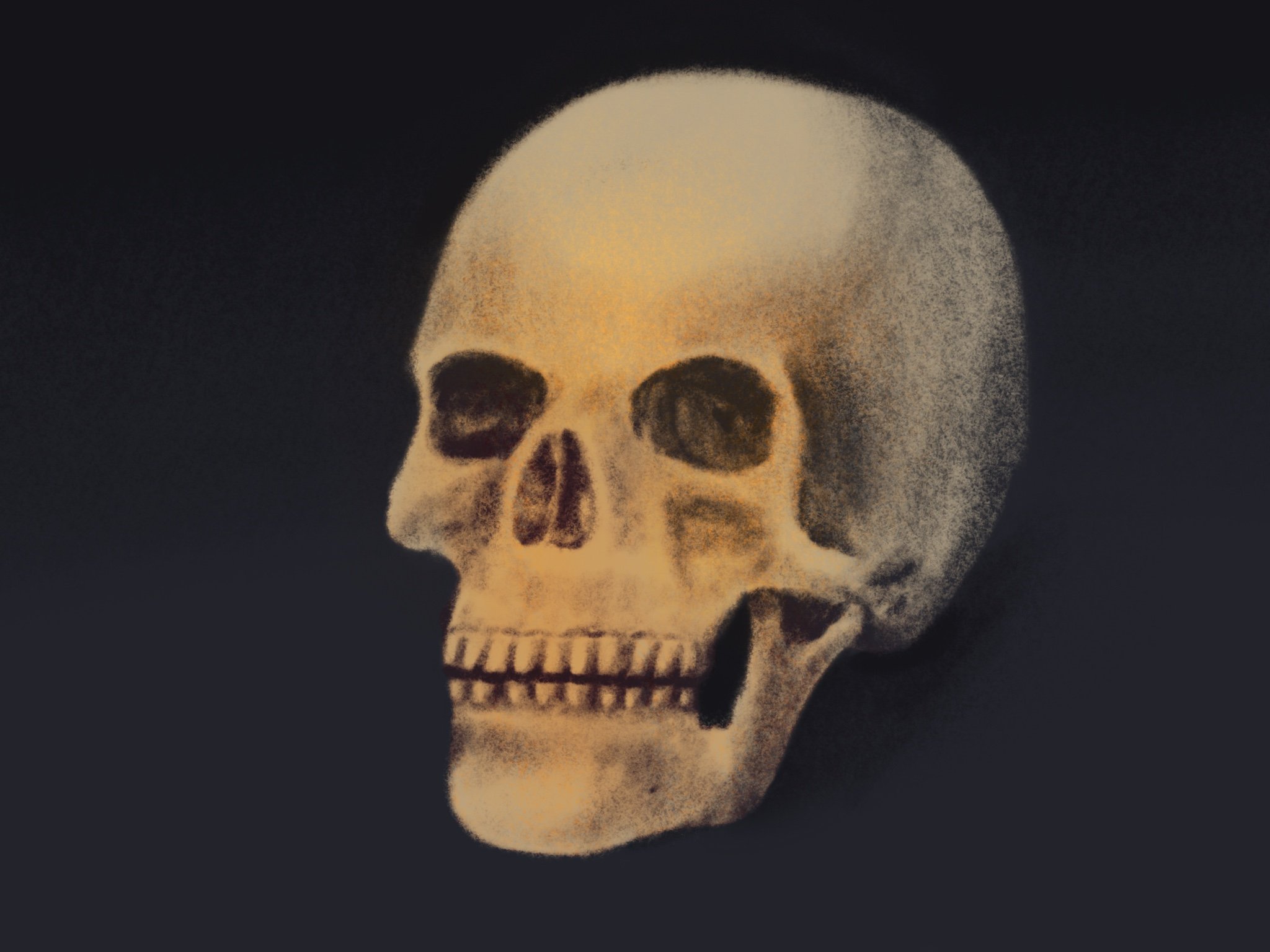
Nathan Apfel
uncannyuncannyuncannyuncannyuncannyuncannyuncannyuncannyuncannyuncanny
uncann
y
—
*
-FIGURES REPRESENTED-
-MAJOR CHARACTERS-
HAMLET, Son to the former, and Nephew to the present King of Denmark
GHOST, Spirit to the former King of Denmark
CLAUDIUS, King of Denmark
KANT, A perturbed onlooker
NATURE, A mystifying sort which tends to wild
SCHELLING, Kant with a little more bling, roommate to Hegel at Tübingen seminary
FREUD, Father to two sons
JENTSCH, First Son to Freud and/or Grandfather (depending on how you look at it)
TODOROV, Second Son to Freud
-MINOR CHARACTERS-
CHORUS, Porters, attendants, ladies, lords, & men – with the voice of reason, what doors might they open?
WORD, The protagonist, also known as the ask & the answer, the sometimes exotic dancer
MEMORY (she/her), Love’s chosen drag name
IMAGINATION, A sweet fantasy
SELF-CONSCIOUSNESS, A delight twice as nice as Imagination’s vice
PLAY, Everything – alternatively, and sometimes at the same time – Nothing
*
Contents
*
-ACT I-
-SCENE 1-
[A thumb uncorks some crystalline vessel, and out rises aromas that twinkle as they ripple. An incense of a different kind, the scents know not “seems” but “is,” they jog the mind to ponder and defy what had formerly seemed merely didactic.]
MEMORY at her post, reclining on the couch, extravagantly dressed in full drag attire to the hue of bright orange. If you squint a little, she seems to blend into the couch—or the couch into her—no one’s ever been quite sure. Behind lurks the practitioner chair.
Enter FREUD, alone, cigar dangling in his left hand — always in his left hand. It’s closer to the heart that way, and home is where he goes on psychoanalytic holiday.
You’re reminded of the time he said, “Sometimes a cigar is just a cigar,” but alas you can’t quite remember if he said it exactly that way. It’s his ‘weapon in the combat of life’ — you roll your eyes — but the word to be heard leaves you alert in surprise —
FREUD
Who’s there?
MEMORY
Me. Rise, and unfold yourself.
FREUD
Lo, but you ought to unfold yourself, in all your sumptuous glory.
MEMORY
Quite right, but hesitate not, for decisiveness is merry.
MEMORY slowly, tastefully, sits upright, shifts a little, loosens her kimono, and unfolds.
FREUD’s gaze voraciously imbibes. He enters, and is transported home.
And of all the words which encircle him in wonder, the lone one he remembers is thus: “uncanny.”
When he returns he makes note of his most recent word-association exercise, writing atop in letters big and bold, cigar enthroned:
DAS UNHEIMLICHE.
‘THE UNCANNY.’
And what ensues is an etymological ruse; it expounds a concept terrible and alive.
He’s dictionary-diligent, seeks translations across alphabets, catalogues all mentions, and ruminates without pretension.
He thinks to the time he read his first Son, JENTSCH, The Sandman by ETA Hoffman and how his Son reacted with fearful delight and how he himself was left in bewilderment alike.
But the more entangled he grows in MEMORY the more his Son assumes the form of his Grandfather. The Oedipus complex turns and sets its sights on him and with great chagrin he remembers JENTSCH fixated on children even before him.
He pages through JENTSCH’s work, “On the Psychology of the Uncanny,” yet the same devouring desire decides he must criticize what he, left alone, would have himself surmised.
So he does. With a nasty bite on his cigar — it is just a cigar, after all — he pours himself over the parchment and pants and snuffs and smokes and groans — and with a flourish writes an essay the whole world would come to know.
FREUD
“Das Unheimliche.”
The Uncanny.
In it, he criticizes JENTSCH, peruses etymological evidence, before directing this same erotic energy toward his new favorite philosopher: SCHELLING.
FREUD
What a limited substrate is Jentsch! And with observations so infertile in function. To think the “uncanny” as synonymous with what is merely frightening is such a gross reduction! That to achieve the uncanny, hesitation be the lone condition—what folly it would be if e’er I weren’t here to spare real erudition.
Enter SCHELLING as an illusory figment of FREUD’s love-tossed imagination, a Ghost or a Geist or a spirit unsure, that uncertainty occludes the very eye you’ve been looking for.
SCHELLING
Alas! Feast thy eyes upon my erudition exercise:
“Unheimlich” is the name for everything
That ought to have remained secret and
Hidden but has instead come to light.
What thinks you of this dignified delight?
And FREUD, overwhelmed, enraptured, breathless and wan, races ‘cross catalytic vortex spaces where grey matter is long foregone. And he thinks and sees and feels and hears and, caught by a dripping in his left ear, Second Son TODOROV spawns.
Little JENTSCH is all grown up now — how time flies in your maelstrom of a mind — but Father FREUD’s hot on the burner; he’s got plenty of thermo to seed one’s inner inferno—and all the vectors seem somehow more phallic now, sharp-tipped swords sweet as little’s TODOROV’s even littler toes with a hint of something acrid you’ll probably never come to know. And maybe you’re better off for it; the interpretation of dreams is a livid nightmare. Reread, relive, retreat, remember: no leering succubus on thy chest can compare, to sand in your sleepy eyes and vanitas warfare!
SCHELLING has likely exited by now, FREUD is unaware how, where’s our MEMORY now?—Half-lucid and half-lunacy, cigar in tow, he’s living through Hoffman’s little scene—he used to read the story to JENTSCH and now that there’s another he might as well read “The Sandman” to the newest brother; the second Son or something to FREUD yet strangely filial to JENTSCH, an essay niggles in thy brain and hesitation’s the lone due pain…
Family lineages are tricky these days, but no matter, for in these incestuous sheets a direct mention of Shakespeare’s HAMLET leaves us writhing in our seats.
So we writhe—or do we hesitate?—JENTSCH and FREUD and TODOROV… or maybe all or none? The uncanny’s pregnant with Herculean fun, FREUD’s essay is all but done, and though the rest is unclear one thing’s for sure: something is rotten in the state of Denmark and “Das Unheimliche” receives the page earmark.
And who better to carry on our psychoanalytic method than sweet HAMLET in mourning garments? Hard pressed to find a more introspective, turbulent, and troubled young lad, one with literary sensitivities who treats words as all he’s ever had, FREUD scours the dictionary for all entries on the “unheimlich”—the ‘uncanny’—yet he misses the most obvious one, little starling dove Prince of Denmark brooding in his angsty melancholy.
FREUD notes the relation of “unheimlich” and “heimlich”—literally, “unhomely” and “homely” though the former is usually translated to “uncanny”—and believes the uncanny be a subspecies of the homely, something estranged from what was familiar formerly.
FREUD
[aside] So enter English etymologies, literature,
Maketh one comprehensive picture!
Woe not! When vision eludes dictation
And introduces strange psychological friction
Enter studies and pontificated follies,
The subject of the uncanny has just begun
‘Til the substance of Jentsch can nev’r be outdone!
And he reads that the etymology of “heim”—“home” in English—directly relates to words like “haunt,” “settle,” “dwell,”—and “hamlet.”
So enter HAMLET and his words.
FREUD
… Something that ought to have remained hidden but instead has come to light…
HAMLET
Muttering under his breath, suddenly exclaims
That time is out of joint: O cursed spite,
That ever I was born to set it right!
FREUD
… come to light…
And like an apparition, enter the GHOST into—
HAMLET
What a sight!
A visage before my eyes!
My father!—methinks I see my father.
Such was the very armour he had on
When he the ambitious Norway combated.
Exeunt all but Hamlet
My father’s spirit in arms! all is not well;
I doubt some foul play: would the night were come!
Till then sit still, my soul: foul deeds will rise,
Though all the earth o’erwhelm them, to men’s eyes.
Exit.
-SCENE 2-
Enter GHOST and HAMLET
GHOST
I am thy father’s spirit
Doom’d for a certain term to walk the night,
And brood, think, and introspect with thee alike
Till the foul crimes done in my days of nature
Are pacified as idle embers of the doleful deed
I could to thee unfold whose lightest word
Would harrow up thy soul, freeze thy young blood,
Make thy two ears, like stars, start from their spheres
A dizzying madness most foul and unnatural
A murder from that incestuous, that adulterate beast,
Whose wicked flesh haunts me by day and by night
Stings my heart as a serpent spawned from Denmark’s
Unweeded garden. His poison-dart sword caught my
Unsuspecting ear with surprise, a complacent nature
Confident and fair, I didn’t hear who was there,
Thus was I, sleeping, by a brother’s hand
Of life, of crown, of queen, at once dispatch’d:
The serpent that did sting thy father’s life
Now wears his crown. Hamlet, remember me:
Revenge upon him your most ecstatic strife
Dip thy pen in a well of virtuous venom
To be kind you must be cruel, and use your
Gifts well to press into wicked flesh
Words that cut deeper than a knife
Conjure ideas strange and true
Which no living conscience can deny.
Exit.
HAMLET
[Shaking with quivering speech]
O God! By heavens ‘tis true, ‘tis true, a
Murder most foul, as in the best it is;
But this most foul, strange and unnatural
Affair to perchance befall my quiet days
[Louder, with conviction]
Dispatch myself with haste, I will
With wings as swift as meditation or the
Thoughts of love, put what is uncanny in its home
And restore the order of the crown!
Exit.
-SCENE 3-
Enter FREUD and MEMORY
FREUD
Poor boy, if what Memory serves is true
And noble, in form enthroned by virtue
Mischief most brutish, not the least unkind
‘Tis good: what was hidden has now come to light.
MEMORY
Memory intones a faithful verse, trickles
Down thy ear to remind of a curse
Some say I sting, but others yet I save,
Inducing visions and visages alike
Which worm into thy brain, burrow
In the mind, open up thy eyes, echo
In thy ear with paranoia paradise. But
I have that within which passeth show;
These but the trappings and the suits of woe.
Long permeated King Claudius,
‘Tis time I plot my own, his wheels
Are but stagnant, it’s time for him to know
A vision seeded shall continue to grow:
Hamlet will revenge his father’s serpent foe.
Exeunt.
Enter CLAUDIUS and HAMLET, followed at a distance by NATURE and MEMORY.
CLAUDIUS
‘Tis sweet and commendable in your nature, Hamlet,
To give these mourning duties to your father:
But, you must know, your father lost a father;
That father lost, lost his, and the survivor bound
In filial obligation for some term
To do obsequious sorrow, but pray,
Do not for ever with thy vailed lids
Seek for thy noble father in the dust:
Thou know’st ‘tis common; all that lives must die,
Passing through nature to eternity.
NATURE
[aside to Hamlet]
That may be true, but something lies truer thus
That underneath certain sheets a serpent lurks
In the dusk. ‘Tis rare and of unnatural crime
To pass to eternity before one’s chosen time.
MEMORY
[Beneath]
The seed has set. Weeds grow from rank things
But what’s fair bears fruit fine and true.
Hamlet must venture into the centre
And seeth through Claudius’ kingly ruse.
Exeunt all but HAMLET.
HAMLET
My father lost a father but whatfore did
I lose mine? Approached by my father’s Ghost,
He haunteth the inner gears of my mind,
Let it stand: I must avenge the man I love most
Yet I plot and I write, inflicting imaginings
Of must wicked spite. What more ought I do,
A fire burns in my mind and I must let it through!
Exit.
-ACT II-
Later that evening, before the peal of midnight, HAMLET sleeps in his dressing room.
Enter a PORTER. Unnoticed, WORD silently slips in behind.
The PORTER knocks, waking HAMLET.
He enters before a response is given, is disheveled, dirty, perhaps belonging to the GHOST night-watch party. A craze glints in his left eye but the right is duly focused on the stirring young lad in front of him. This is his regular post; he knows HAMLET’s been a bit more of a fitful sleeper, after his father’s death, than perhaps usual.
Whatever mad, uncanny behavior others may have noticed in HAMLET lay unmatched to his current disposition and its volatile message for which he’s dispatched.
PORTER
[Speaks as though suddenly possessed]
A play within a play like a poison-tipped knife,
The word is scant heard lest one puncture into life.
And what’s a knife, after all, but a scaled-down kin of sword, tragedy lurks in indelible works when pen hits the drawing board.
So
Enter the WORD
WORD
Draw your sword, advance forward,
All’s fair in love and war
And Denmark’s the mortal cord!
A fully lucid HAMLET leaps out of bed, draws his sword, for what has he heard but the galvanizing proselytizing of some ambient WORD?
HAMLET
Who’s there?
WORD
Nay, answer me: stand, and unfold yourself.
Enter MEMORY, swiftly and stealthily.
MEMORY
Long live the king!
Retreats into the shadows.
HAMLET
I am my father’s son; long live his dynasty!
What sayeth you of a king when another
Lives on in purgatory! Truer and valiant,
The very image of moral and confident,
What serpent’s sting, him to dust brings,
And mourning colours donned for but a
Moment lay inert, and now to naught cling!
MEMORY
Our sight converges on the same king
We speak of when Denmark we think of
But your father lost a father too, now he’s
The one gone. Your name is, too, fair Hamlet,
Lest it rest on some seducing clown’s head,
The crown is yours to wear, you need only
Weed out the bed. So draw your sword,
Advance forward, dress in armour like
Your father’s Norway battle-score.
HAMLET
The Ghost, you see him too?
MEMORY
What do you think?
For you are me and I am you.
Enter SELF-CONSCIOUSNESS.
HAMLET, unaware of the entrance, returns to sleep, spent and exhausted. Turbulent dreams ensue.
SELF-CONSCIOUSNESS
Get thee to a nunnery, hide in incestuous sheets,
Spark rivals in thine mind, imaginative ecstasies
Crueler yet kinder thus, they atone for caprice,
Feed on the pith of Life stung by an adulterate beast,
An antic disposition beckons you to make peace,
For some must watch, while some must sleep.
HAMLET wakes again.
[SELF-CONSCIOUSNESS continues, but treads more lightly now]
Some cruelty lay in innocence, but in being cruel
One must not jeopardize future holiness.
You are your father’s son; his face of righteousness
So imitate with care under the guise of true madness.
HAMLET
What am I to think, what am I to do?
How mighty might this pen become if I expand
What lay in my purview? There are more things in heaven
And earth, Memory, than exist in your abstract philosophy.
I know who I am, ratiocinating man,
My Imagination sets me free.
And yet: am I a coward?
Who calls me villain? Am I naïve?
When I know of things more wondrous and strange
Than e’er common sense would let me believe.
What form to rectify my father ought I to arrange:
A play within a play might a poisoned knife be
So that crimes laid to bed may well haunt from their sleep.
Exeunt.
-ACT III-
-SCENE 1-
Enter WORD and IMAGINATION, trailing behind.
WORD
Have you interpreted your dreams yet?
Associated with things like me, things like
Yourself, things like counting sheep?
To be or not to be – that is the question –
Now mine: are you open to this suggestion?
IMAGINATION
I open for you at once, always, dwell in
These contemplative lingerings. With words
I erect my home, bound to thought but not to
Action, thus spake I alone: In the beginning
Was the word, and the word was with one,
And the word was one – and one must take
Arms against a sea of troubles, for in that
Sleep of death what dreams may come?
WORD
Yes, good, continue association,
The word is heard but actions speak louder
So speak louder, friend, articulate transference
Ask: O sweet fantasy dream, does there loom
An illusion-cloaking childhood doom,
One which stings and shatters innocence
And appears as haunted unconsciousness?
Enter FREUD with a stalk, walk, cigar-stained baulk. He’s a moody one, that chap, and as he puffs the ashes settle over parchment into a Rorschach ink-blot map. And this map he ponders, studies, gropes for opaque meanings. He wonders, when we have shuffled off this mortal coil, what may be left of our labor and toil?
FREUD
A play within a play like a dream within a dream,
Heed the fair word because imagination is key.
So he takes his key, his imagination set alight, and—fondling whore, serpentine bore—he penetrates the night! Opium eyes opened to a perfume gaze, he dreams of the WORD and its awful, throbbing veins.
And he lands on transference, a thing wretched, rending, identity-bending, but alas productive as it indicates repressed trauma may be yet surfacing.
So he adds to his manifesto of curiosities:
Doppelgänger, repetition, evil eye, superstition, animastic enterprise, and what magic thickly-laced with maddening precision.
FREUD
Hamlet! He’s done it! Begun acting like his father
Assumed the face of shiny, opportune armor
Generational transference with a crown to entrust
But Hamlet’s no warrior without Imagination’s pixie dust.
Imitation binds his bust, two I’s to see for the blind
And contemplation’s e’er dwelling on the mind.
HAMLET
This quintessence of dust! All the best of mankind!
Lifts a skull from the soil
Rotten vegetables among weeds and Alexander’s
Food for the trees. Imperious Caesar,
Dead and turn’d to clay
Might stop a hole to keep the wind away:
O, that the earth, which kept the world in awe,
Should patch a wall to expel the winter flaw
And what will I be, wicked etymology, when
Imagination traces the noble dust of birth
Yet the skull quips: Imitation got there first.
Enter the GHOST in limbo, in hesitation, on a threshold.
And HAMLET wonders where his own demons lie. Thresholds are fickle creatures, for they blot out an uncanny sort of dye.
Exeunt all, but what little remains manages to haunt such fair noetic strains.
-SCENE 2-
Enter CLAUDIUS, who kneels, prostrates, and pretends. Enter HAMLET, a stealth little spirit, seeing, thinking, and self-vacillating.
HAMLET
Now might I do it pat, now he is praying;
And now I’ll do’t. Courage is thick in the air
And offers a concession, an easy confession
One quick dispatch, and it’ll soon be done
No blood left on my hands as I watch
My father’s injustice idly over-run.
Nay, this fruit will disappear if just
I let blood flow from my lawless foe.
Incestuous sheets can be washed anew,
Rung by hands bent kind and cruel
Yet do I now start, he goes to heaven;
And so I am revenged. That would be scann’d:
A villain kills my father; and for that,
I, his sole son, do the same villain send
To heaven. No, I cannot, it would be a
Crime at twice the price for which no
Amount of repentance could e’er suffice.
I must patient be, which, to be honest,
Finds me not entirely unfavorably.
Up, sword; and know thou a more horrid hent:
When he is drunk asleep, or in his rage,
Or in the incestuous pleasure of his bed;
At gaming, swearing, or about some act
That has no relish of salvation in’t;
Then trip him, that his heels may kick at heaven,
And that his soul may be as damn’d and black
As hell, whereto it goes. And I, righteous,
Emerge clean and true, and nature, victorious.
CLAUDIUS
[Kneeling]
O, my offence is rank it smells to heaven;
It hath the primal eldest curse upon’t,
A brother’s murder. Pray can I not,
Though my inclination be as sharp as will:
My stronger guilt defeats my strong intent still
‘Tis of no use, what’s done is done,
Fair is foul, and O was the foul such fun
But alas, consequence is in the air
If it be that way, no criminal will be set fair!
My words fly up, my thoughts remain below:
Words without thoughts never to heaven go.
Exeunt.
In a state of perpetual in-betweens, CLAUDIUS, his familial GHOST, and son-in-law HAMLET are not so different as they may seem. Haunted by prior actions or pure words or presumed misdeeds, we dwell in a threshold hell and hesitation reigns supreme.
-SCENE 3-
Enter TODOROV, all grown up, the big man on the block. KANT follows behind, readjusting his watch clock.
TODOROV
[Pontificating, gesticulating wildly]
Kant, we’ve been over this before, dear,
For such a man of categories, you’d do well to hearken near,
I present thee: marvelous, uncanny, and hesitation’s fear.
KANT, miffed, reclines in the armchair, arms staunchly folded, lips pressed, eyes unconvinced, and sits in silence, a hesitation of his own stark volition.
TODOROV, unphased, dictates:
Fear and perplexity, in a situation strange,
Oft warrant the conditions to, themselves, rearrange
Cognitive structures and a genre’s specific station
The fantastic lasts only as long as a reader’s hesitation.
Firm resolution, when word punctures into reality,
When madness is utilized to create a necessary ambiguity,
Only then could the Ghost be explained or accepted
Into categories ‘uncanny’ or the ‘marvelous’ perfected.
Such an awful, fantastic snare might entail
Poison in an ear and a hasty wedding veil
Opaque to the truth of Denmark’s duplicity
Unsure, he hesitates in dark shades of dour
When Hamlet dwells in moments uncertain
Knows not who may be yet hiding behind the curtain
And draws his sword with a firm resolution
And punctures a foe alike, but not his intention,
Feel he the same anguish as in his lethargy?
When he dare not act, always instead conspiring?
What alibi hath the criminal made for craft
And can it escape Hamlet’s noble-true tact?
What serpentine digits hug his mother’s thighs
With kisses of innocence, e’er laced with sharp lies?
And who to trust, who to condemn
When your uncle was once your father’s dearest friend?
What of your own friends, and what of your lover, too,
Could she be pregnant with the same weed planted anew?
And what of the flowers, whose beauty delights,
Perfumes banquet dinners and later, incestuous nights?
The meat hath not yet grown cold
But funerary rites are over and told
What of my own flesh, my sinews and bones
Could dust be the conclusion of my rightful throne?
Must I mingle I with Alexander
To know but little of the truth of my good father?
The state of nature is out of tune
But vengeance promises, alas, the urgent boon
When wrongs are set right,
Only then might my nation delight
I need only ensure a certain damnation
Make the fantastic uncanny and
Exit HESITATION.
KANT
Son, you wax poetic, in this tasteful analysis
I think you’ve got it right: hesitation is paralysis
Ruminate you must, but champion dynamism
For stalled limbs restrict agile mental mechanism
In the face of the grand and numerous alike
When e’er overwhelmed by an experience sublime
One awful, brutish, nasty, or blithe and mellifluous
Confronting harsh truths of the self like Oedipus
We realize our cognitive faculties are but limited
The imagination must become, with intellect, assimilated.
Like young Jentsch, we are finite substrates
Shuffling on and off mortal coils, fixating to imitate.
But let our faculties bear fruit and expression,
A venom sweeter than any self-confession.
Let them intertwine, refine, imagination unconstrained
By cognitive categories and concepts feigned; nay!
I challenge the two: harmonize in a game of free play
That incestuous nights might break into day!
HAMLET
I challenge you to a —
Enter HESITATION, arm looped through a certain TODOROV, smug and emboldened by KANT’s resounding endorsement, he sits up straighter, sniffs, reclines, and almost appears like his father FREUD, sated. He squints into HAMLET’s swan-like sclera as the young sapling freezes, fated, forever passive in a game of play, no player is he when the sun dawns on the day, and old CLAUDIUS still lives! We just can’t get rid of him!
—Everyone in this damned facility
Is but damned by my own damned ability!
I ruminate and resist
Hesitate and desist,
For purpose is but the slave to memory,
Of violent birth but poor validity,
And am I those players my crown’s courts abuse?
Who twirl for the devil; ‘tis time they refuse –
AND I SHALL TOO, the most damned of them all,
They feel they are saved but I know they shall fall
And should I fall too, in this judicious haste
A noble heart may crack but it won’t go to waste,
It is but enough, I know my given station
The fruits of which must live on in my nation
To be or not to be? I’ll throw to the wind: LET BE!
Life oft’ gives twice-chances, but for me
I am the second chance, second in command, e’er unlucky,
I AM MY FATHER’S SON; whether I do or I die
I must show my hand and pen this second play sly.
Enter PLAY who exists hesitation, escorts our dear HAMLET, calms his wild gesticulations. He is to enter a poisoned-tipped squall, oxygen cold like the smoke on his pall. Vengeance is a tender subject, that’s for sure, but only by a garden-clean slate will one be the cure.
And HAMLET, with certainty alas, proclaims to his handsome prowess, awakes to his mind and his heart’s unity, his imagination and intellect wed to eternity.
[continues] I challenge you to a—
PLAY
— duel of the duals, from the second to one,
One against one, soon the court will be none,
Two is a dual engaged in a duel; three is a company
But four is a crowd, what’s a few more worth in this
Serpentine rain-cloud? And what might rain down but
A cold chalice in despair, e’er the bashful, playful,
To banal dancing pairs! If you die for your father then
Why did he live for you? If you cry for your mother, ask
What she can really do? She swooned for a brother
But you swooned for a snitch, played as a lover but was our
Denmark’s finest bitch! And this King serves his schemes
With a side of hell-bent morphine;
Though justice may be served, you must still die.
The play remains and the birds still chirp in the sky.
HESITATION stirs, satisfied with his interruption.
KANT watches from afar, pitying HAMLET.
KANT
And am I satisfied? Hamlet played the game,
Washed hesitation from his noble father’s name
Yet his pool of blood so deep waded into
Left him in a limbo less fortunate than his kin’s fare,
True state of being, of imagination and of thinking,
His second play of swords knew itself like
His first play of words which cut Claudius’ life-cord.
They shuffled off it in a battle brutish and cruel,
My eye for free play has been set and achieved,
But where is the heart in the midst of tragedy?
Where is my mind now that
HAMLET
My consciousness has left me!
Dies.
KANT
No! My sapling! My soft, tender fern!
So verdant with life and yet dour with mourn.
Misfortune glitters with a capillary sting
Pierces through like a poisoned beetle-wing
Stitched across dissonance, a continental divide
When cognition sears conscience with bright eyes wide
Shut to the chore like lacunae in the truth
He still graduates to a rank in his youth
Yet one more hasty but less brash and less stately,
Noble fires do haunt the ashes of fury.
Exeunt.
-ACT IV-
-SCENE 1-
And glorious ashes they may be, silvery with a scant smell of the salty serpentine, for CLAUDIUS lives on under rusty nails and bindings. A reminder of the delicacy of truth, he departs with the question if it’s more fragile than you. Humans are the most fickle of material things, we sparkle and we glitter and flame out as ravishing kings, we create and we cry, defecate and then die, but somewhere in the prison of strife a star is born to the chorus of life, it weaves and it woes, it bleeds for its foes, and one may sing to it in soft lullabies, pouring sweet love-wax in the ear of a charmer in disguise. For all predators are to someone else prey, CLAUDIUS waits for his coronation as he waits to be slain, for he did upon others as will be done upon himself, and memories of former misdeeds haunt above all grave things else. Pray, try he might, but at the end he must set his conscience back right, must cleanse the evil serpentine hands from clouding his ambitious sight, for what’s to say he won’t succumb to the chimera of a poison-tipped knife? HAMLET’s first play caused him quite a disruption; action, decision, cognitive tunnel-vision — could not escape hesitation, rumination, guilty trepidation—and at the end HAMLET pays with his own nation. FREUD looks on with pity and keen interest, for it was his father’s image that ignited the very first transference, young Hamlet crowned with battle-worn attire, yet hesitation won again as it jousted him a liar. An antic disposition could not compare, to the aurora borealis dawning on FREUD’s reclining chair.
Alas, enter CHORUS.
CHORUS
An action demands an equal and opposite reaction,
Vengeance atones injustice’s scaly faction.
When all wrongs grow right with the first morning’s dawn,
The garden has been weeded but our sapling still lives on.
For mortal coils are never simple nor fair,
They slink with sure eyes and they squeeze as they stare
From their silver-sweet tooth, hot venom glistens and drips
Opalescent from some lucky charmer’s serpentine lips.
Claudius is not alone in turning friend into foe
For Hamlet, too, has his own inner demon and ghost,
‘Who’s there?’
‘Son, I am’
Haunted by his father’s form
As by certain social decorum that governs traitorous norm,
Haunted by his inaction as he planned an inert-stained reaction,
He thought his enemy were mortal when really its name is ‘abstraction.’
So Hamlet joins purgatory and there he meets his old man
Who opens his mouth and utters,
‘Son, I’m glad to see you again’
You were valiant and fierce, yet nature found her way to pierce
Your play within a play with a poison-tipped knife,
Your word was scant heard ‘til you punctured into life
So you sprang and you sparred, battled foes near and far,
But the inner workings of your mind were your fated love-crossed star.
Hesitation preyed on him when he prayed it away,
Kneeled before the altar hoping duty would save the day
But found that he, like Claudius, his lesser enemy
Alas dare not pray, and stalled and hesitated with that final fear:
Tragedy lurks in indelible works
Which percolate one’s consciousness by way of ear.
So the GHOST had a message to deliver brisk and true
Haunted his son with emphatic requests to do
Upon Claudius as was done upon him
But the conflict of the faculties let no one win.
CHORUS stills, then continues with heightened feverishness.
Jentsch felt this same conflict, studied the childhood tales
That wormed into his adulthood, whose inner child left assailed,
Dissatisfied, traumatized, and e’er frightened to sleep at night,
Who lay awake and aware for poison in his ear or sand in his eye.
Self-awareness, he says, is a catalytic force, for
A feeling of latent animation
Lingers in the skull in thy hand or the still-life-sized altercation
Of chalices and swords, of scruple and pens,
Of serpentine poison poured among families and friends
When the familiar is abandoned for complete disorientation
Which eludes all clarity for the favored, uncanny station
Of the e’er searching mind, for in moments of hesitation
The question looms grand of our life’s orientation:
Toward heaven or hell or another round on this mortal spell
Pontificate, shuffle, joust as you might, only time will tell
If decisiveness should set you free or if play will take the lead,
If the uncanny curse of hesitation shall haunt you ‘til you bleed.
Will you converge on the ‘marvelous’ or the ‘uncanny,’ or will you dwell in the fantastic’s ripe uncertainty?
When skeletons don your pantsuit and tie, and calcium smothers your cravat’s starchy cry,
When the cigar blinks out at the clock’s coo of night, whose legacy lives on and whose must die?
Where will you make a home for all the things you’ll never know?
What will you sacrifice for the prodigies you promote?
CHORUS shuffles, reaches, retracts, and orders, winks in synchronization, then takes two steps forward.
The audience is afraid now, as if they’re watching their own world.
And they know it.
For self-awareness is key and this play is potent.
-SCENE 2-
GHOST
[Emphatically]
A play within a play like a poison-tipped knife,
The word is scant heard lest one puncture into life.
And what’s a knife, after all, but a scaled-down kin of sword, tragedy haunts in grotesque little jaunts when one deceives the high and mighty lord.
So
Enter the WORD
WORD
Draw your sword, advance forward,
All’s fair in love and war
And hesitation’s the umbilical cord!
KANT, currently reclining, sits up with a start, profusely sweating, heart pounding, dissonance sounding, haunted by the fruits of his creation, his tree of knowledge and what forbidden delights bloomed from its deceitful uncanny-coloured frights.
KANT
Who’s there?
PLAY
Nay, answer me: stand, and unfold yourself.
I’ll speak in your tongue like your kind does when young.
Quite simply, your mind games offend the rules of my name,
You think play productive when it explodes thy brain.
Why may your cognition play when others must fight
When Hamlet alone braves the horrors of the night?
You stepped up with your word, I’ll commend you for that
But you took it too far when hesitation became tact
In the process of uniting the intellect and imagination
To conveniently serve your self-assured aesthetic function,
You search for a cause but you forget of intention
A mistake exhibited by Hamlet’s wry reputation
One like your own as though our sapling were a child
To a father and messenger unlike the brazen, warrior-profile
Who haunts you to this day, who dwells in your mind?
Your creations are monsters with soft-fur made to find
Every pore of insecurity, uncertainty, superstition, and lore
And exploit with a smirk everything come to light,
What ought to have remained hidden—that’s what Schelling would have said—and he’ll articulate it later in a letter to a friend, and
FREUD looks upon the scene, sees destruction of all shades cruel and mean, but his intrigue ignites his inner child who to this day haunts him and he feels something vaguely incestuous is the true uncanny’s origin.
So he dictates this tale to his kin, presents hesitation as the true human condition. Between two blips of unexistence, it is the grey matter, pneuma, and the kind, loving memory. It is the mirror-image, kindred lineage of our figures before and all those yet unborn that will inextricably weave into the fabric of life’s lore. But like dear HAMLET, hesitation has been mischaracterized. ‘Tis dispatched, decried, overlooked, minimized. What if it is not a cessation, an abandonment of station, but a high and mighty force with echoes of play in its sanguine voice? An intermediate of vicissitudinous period, is it a possibility, that PLAY, evil as can be, might actually raise the Id’s cognitive faculty? Might resonate with one’s conscience to set oneself free? Might make a home for the uncanny latched by haunting’s gleaming key?
FREUD remembers when HAMLET exclaimed:
HAMLET
What a piece of work is a man! how noble in reason!
How infinite in faculty! in form and moving how
Express and admirable! in action how like an angel!
In apprehension how like a god! the beauty of the
World! the paragon of animals! And yet, to me,
What is this quintessence of dust?
[Examines a skull and sees his father winking back at him]
Visage of HAMLET vanishes. CHORUS resumes.
CHORUS
Freud, bless him, believes in the paragon of animals,
Knows he is a piece of work, that he must therefore toil
For reason to ennoble and cognitive faculties to extend
For imagination express and admirable to apprehend
Like a god. For he is a god. We are all gods to him,
From infants to kings to every measure of this fragile kin.
So he draws his sword
Advances forward
Becomes the poet and
Enters the word.
-ACT V-
FREUD
[Aside]
The poet can produce far more poignant encounters with the uncanny than real life ever could, the power of the poet presides over a universe of death, they are the ultimate master of the word, of the sword. The genius whose pen perseveres against extinction, disbelief lay in willing suspension, ‘tis adorned with loving memory with kind eyes set on doubleness and duplicity. I mustn’t be so hard on dear Hamlet or Kant, for they made art and gave it room to play, it is merely a fact of life that hesitation entangled, got in the way. Alas, all the fruits of my still-life, skull-rife dreams swell and ripen, the uncanny is that which induces hesitation, the haunting of the past upon the present, the external upon one’s own, the imagination upon one’s cognitive disposition, artifice on the collective conscious home.
The only certainty, the only escape from purgatory, is what an essay study of etymology beholds of how tall the haunting of the seeded word has grown.
Not all fugues collapse in crescendo, not all tragedies conclude in despair. For some must live on to light the next century, and others must dwell in imaginative ontologies.
And so “Das Unheimliche” sleeps soundly at night, knowing its golden-trembling knife has paired Play with poetic faith so the word may create its own life.
[FINIS]
Artist’s Statement
Imaginative Ontologies
Slightly-Less-Fear Shakespeare
Notice: straight roads are boring! A circuitous path ensues.
Prepare to be cast into a world of make-believe
Where goblin and friend co-conspire to deceive
Brave souls and fair saplings may desire a reprieve
From what toil they feel from the truths they perceive.
Preface
A play within a play like a poison-tipped knife,
The word is scant heard lest one puncture into life.
– A Porter [XXX]
*
[Knocking within. Enter a PORTER]
Act II, Scene 3 of Shakespeare’s Macbeth opens with a Porter’s soliloquy. Immediately following the violent murder of King Duncan and preceding the crime’s discovery by the play’s protagonist, Macbeth, this scene memorably spotlights a minor character, a Porter. He’s clever, he plays make-believe, imagines himself as a Porter at the gates of hell—and lo, he is; he presides over the gates of Macbeth’s residence, a newly inoculated hell given the recent turn of affairs with King Duncan’s violent departure off the very “mortal coil” that so wrung Hamlet’s conscience in Shakespeare’s earlier tragedy, Hamlet, The Prince of Denmark. While the figure of a Porter does not explicitly feature in Hamlet, the Porter is a message-bearer, a prophetic figure—he foreshadows Macbeth’s illicit deeds and consequent demise—such that the character Hamlet might be seen, in a certain sense, as a dramatic porter himself. The ultimate mastermind pulling all the strings throughout the play, Shakespeare deliberately includes scenes for the sole purpose of demonstrating Hamlet’s supreme wit and intelligence relative to other figures, and much of the interactions between Hamlet and Polonius—characterized as equally superficial and superfluous—endorse the former’s outstanding mental agility. Hamlet is well aware of his strategic station, and consistently uses his imagination to serve his project of revealing his father’s unjust murder to ultimately restore the state of nature, a common trope among Shakespearean tragedies. While the Ghost is described as a portentous figure in Act I, Scene 1, and indeed the GHOST will emerge as the final porter figure, it is worth tracing the currents of dialogue and miscommunication throughout the play as new characters, voices, and concerns are inaugurated, dispatched, some enlivened and angry, others put to sleep in bed.
Introduction & Brief Summary of Hamlet
Hamlet receives a message from the Ghost of his recently murdered father, who, while alive, reigned as the celebrated King of Denmark. Much like the untimely and cruel murder of King Duncan in Macbeth, the dispatch of Hamlet’s father threw the world out of order and the burden fell on Hamlet to make prior wrongs right: “That time is out of joint: O cursed spite, / That ever I was born to set it right!” (XXX). Hamlet learns that his father’s brother, the antagonist Claudius, is the culprit with the cruel sense to pour poison into the unsuspecting, sleeping King’s ear. Indeed, the motif of “ear” and “poison” will repeatedly echo throughout both Shakespeare’s original play and my rendition to signal “That time is out of joint,” that the state of nature is out of order. From this insight, Claudius’ hasty and “incestuous” marriage to Hamlet’s mother, the recently widowed Queen, develops at once an acrid taste in Hamlet’s mouth, the grievous, personal urgency that incites him to expose the murderer and seek revenge. Hamlet has thus assumed a porter’s status; he alone bears the truth of Denmark’s royal politics, and the remainder of the play is his attempt to deliver this message to various figures in various ways, with varying degrees of success.
Hamlet is often criticized for his inability to act, as though he is a timid and weak sort of creature, not at all the face of his brazen father, a champion of conquests and decisive leader. Yet approaching the figure of Hamlet as though he is a porter abates these concerns, for the project of reading Shakespeare’s play is no longer one of asking “Will Hamlet seek revenge?” or “Can he fulfill his late father’s wishes?” or even “When will he — like Lady Macbeth — unsex himself and actually grow a pair?!” Rather, one must treat him with the question of how: “How does Hamlet do what he sets out to do?”
And ladies and gentlemen, his method lay in madness.
Literally. In an aside, a character (Polonius) describes Hamlet, saying, “Though this be madness, yet there is method in’t,” thus alerting the audience to pay attention to Hamlet’s method, one deliberate and clever, yet distinctly aware of the limitations of his tender, turbulent disposition (Act II, Scene 2). Hamlet may not be able to immediately confront Claudius directly, but he knows this, and he instead assumes an “antic disposition” and begins acting strangely with the intention of catching other characters off-guard to collect evidence and extract a confession.
One such method he attempts, successfully, is to present a play which depicts with uncanny accuracy true events in Hamlet’s life through a historical, fictive drama. Whatever madness Hamlet purports is nothing compared to the madness he provokes in the presumed murderer. Internally tormented by a series of Hamlet’s “antic” behaviors, Claudius finally confesses during this play. Since much of Hamlet hinges on situational irony, it is no minor feat for Shakespeare to embed a play within a play. Yet this truth, at present, is relevant almost exclusively to him; Hamlet’s message that Claudius is indubitably the murderer is augmented by this confessional evidence, yet it remains opaque to others. Hamlet is thus emboldened to independently bring justice to his late father with newfound steely determination. This is one example of Hamlet’s vigilante method — cautious though it may be, it is undeniably imaginative and self-conscious.
Such characters aptly appear in my interpretive rendition of Shakespeare’s Hamlet, figured as Imagination and Self-Consciousness, alongside borrowed characters directly transplanted from Shakespeare such as Hamlet, the Ghost of Hamlet’s late father, and others major players. We are, like Hamlet, obliged to invoke our imaginative and self-conscious sensibilities to illuminate truths. I, Roxana Grunenwald, dutiful servant to the aesthetic cause, thereby answer this message with one of my own, in the form of a play. My antic disposition is one of dramatic interpretation, and what follows here is a small exegesis.
Explanation of Method & Psychoanalysis
Claudius himself, in Hamlet, cries: “My words fly up, my thoughts remain below: / Words without thoughts never to heaven go” (Act III, Scene 3). With so much treatment of the spoken word, I will apply and self-justify a method of etymological analysis, yet focus will also be given to the thoughts which inform it, the intention which motivates the action, and the message which demands deliverance. As such, it is important to note that the word “porter” comes from the Greek poros, “journey, passage, way,” and the same Proto-Indo-European root *per- comprises words like “aporia,” “deport,” “farewell,” “opportune,” “opportunity,” “portal,” “portfolio,” “purport,” “practical,” “rapport,” “support,” “transport,” etc. We will follow Hamlet along his journey, through his hesitative aporia and various opportunities, and will do so by entering a ‘portal’ inscribed by my own hand, one which will ‘transport’ us across space and time and story until we understand our own porter’s journey.
Hamlet is an introspective sapling. That, compounded with his striving toward a decisiveness like his father’s—a parallel made explicit by the fact that our protagonist, Hamlet, is actually Hamlet, Jr., to his late father, King Hamlet, Sr. — lends itself to a psychoanalytic reading of the play. Sigmund Freud (1856 – 1939), Austrian founder of the pseudo-science psychoanalysis, coins the concept of “transference:” when one experiences the ‘transference’ of the feelings or desires from an important figure in one’s life, such as the transference of attitudes expressed in King Hamlet, Sr., onto Hamlet, Jr., with the effect that Hamlet is forced to act with previously non-existent confrontation and conviction in his pursuit of vengeance. In this psychoanalytic reading of Hamlet, the transference from father to son occurs with the distressing death of Hamlet’s father, manifests when the Ghost imparts the message to Hamlet, and informs Hamlet’s behaviors — including the decision to troll Claudius with the play — until it reaches its apotheosis in the final scene wrought with mass violence when Hamlet finally confronts Claudius, exposes him as the murderer, and acts to bring final justice. Only then do we see Hamlet imitating his father’s valiance.
Imitation, while not a character, is duly referenced in my rendition of the play, exemplifying Hamlet’s station as a porter and following the message he wishes to convey along various attempts of expression. Tracing the fruits of transference as they bear on Hamlet’s reasoning and antic disposition, this psychoanalytic mode of interpreting Hamlet builds a cosmology of my own. Shakespeare’s characters will appear in conversation — literally — with historical figures such as Freud, the German philosophers who influenced him (Kant, Schelling, and Jentsch), and the literary critic (Todorov) whose theories he, in turn, lay the foundation for. Select concepts essential to Freud’s or Hamlet’s project—or the project of overlaying the two — will be personified into such characters as “Memory,” “Imagination,” “Self-Consciousness,” “Play,” “Nature,” etc. Various levels of conversation will emerge — indeed, characters will seem to materialize or dissipate into the narration, single thoughts may be delegated to multiple figures and voiced in fragments, and an omniscient force presides, too; certain stage directions are often intentionally designed to dole out just enough context to leave the reader sufficiently confused, as though one is caught in an overwhelming vortex of rapturous transport from which one many only exit by journeying through, by wading deeper into the swelling pool of blood, if you may.
Proposition:
This is a play that cannot be performed.
Explanation:
My project is one of cataloguing the collective, capturing the constellation of effervescent glimmers cast into the world by the word which lingers even after the single communicative act has run its course. Centered on a generous reading of the character Hamlet by modulating his environment and interlocutors, Freud’s concept of transference guides my vision, one which studies the influence which so indelibly comprises the substance of all things, the web throbbing with the buoyant energies of a life so diffuse yet interdependent, shimmers like the armour of the Ghost of Hamlet’s father, cloaks our embodied form and haunts our episteme with yet inaccessible irony as though poured into the ear—but this time, the poison which murdered the King is our life-force, our poison-tipped knife puncturing the word from the abstract into its lived world so it can define the message common to all humankind and uncover what precisely the porter in all of us ought to, in ourselves, find.
Conclusion:
This is a play that makes us its performers.
And Kant and Freud look on as observers.
In the good spirit of poetic influence, Shakespeare’s successor in the English literary tradition, John Milton (1608 – 1674), famously remarked in his seminal work Paradise Lost: “The mind is its own place, and in itself / Can make a Heav’n of Hell, a Hell of Heav’n” (Book I, lines 233-34). Perhaps no such mind is called to mind as emphatically as Hamlet’s, and we will assume a porter status familiar to his own to uncover which gates we preside over, and if they perchance dwell in hell, can the mind make a home of them in heaven? What, after all, is the therapeutic power of the mind when we dream big and interpret those dreams alike?
—Forgive my interpolation of literary, historical, theoretical, and imagined figures; the boundary between literature and reality is but limpid when life imitates art. So pellucid and omnipresent one might begin pondering if it exists everywhere, nowhere, or, in fact, within. —
Thus, elements of Shakespeare’s own play—including direct quotations—aptly feature in mine, and one is encouraged to draw parallels—to associate the word of one with that of another, and perhaps with Freud’s broader schematic picture—to develop our practice of imaginative introspection so we, fellow porters, keepers of heaven and hell, may open the mind to doors yet blind when a knock sounds from within and we instinctively ask:
Who’s there?
And answers we might find later that eve when we recline in our armchair.
But before you read on…
Enter HESITATION
A Statement
No matter performer or artist or writer or mad-hatter, I want to acknowledge the occupation of this play (and even this introduction) across all the atoms of my mind and heart. This is perhaps one of the most ambitious undertakings I have ever laid pen to, not simply so in pure length, but in the cognitive dissonance which lingers whenever one pairs one’s own writing alongside Shakespeare’s. Indeed, it was a Herculean task. Having read Hamlet twice through, conducted extensive research into Freud, which led me to Jentsch (which had to be read in the original German), I revisited Todorov’s analysis of the fantastic, and even sustained a brief encounter with Coleridge’s analysis of Hamlet which, while not featuring directly in my play, certainly influenced my rendition, my interpretation of the dream to usher in a new method of scholarship, one that attends to the enlivening poetics of a literary-theoretical garment rather than fixating on its drab, reductive worn-through threads. Indeed, my play can be seen as a personal project to extend imaginative empathy to characters, philosophers, and historical figures in an effort to pronounce with great conviction the golden molecules which link us all, what similarities a fictional character penned at the turn of the 17th century might share with a literary critic writing in the late 1900s. Across geographic locations and traditions and socio-political concerns and interests, my task is to unfold an experience which invites one to think in new, profound ways.
Hamlet, Sr., the Ghost, is the porter in my play, ushering in narratives and doubts that would permeate and transfer to Freud, our observer outside the diegetic bounds of Hamlet’s direct interlocutors. The two plots unfold simultaneously: (1) Hamlet and his interactions with the figurative monsters born from his own turbulent disposition, and (2) Freud, Jentsch, Schelling, Todorov, and Kant who watch, comment, and interact in a new dimension, with new insight to Hamlet’s character, from their afar station of reflection through which they peer through a poros as uncanny truths dare to draw near.
While I originally assumed I could simply footnote all ambiguities, references, word plays, technical facts, and contextual information, it became readily apparent that there were far too many observations to note, that one could write an independent paper of equal length analyzing and tracing my invocation of certain tropes and phrases throughout my short play. Thus became my revised task: to write a supplemental exegesis commenting on and explaining the play. It began as you have read here, yet again this proved near impossible, for the more I endeavored to understand the inner workings of Hamlet’s turbulent mind, the craft of Shakespeare’s unique poetic formulations, and synthesize all this with the complex theories of some of the philosophers most near and dear to my heart, I realized I lost the necessary distance to adequately reflect on the mechanics of the play. But rest assured: I have, of course, achieved far greater insight through immersion, one intimate and strange, and one for which I will be forever grateful for opening my ears to hear of twinkling delights in a new way. Just as the play eludes performance, so perhaps does it elude strict commentary, and as I continue to reread and revise it now, I feel it has reached a coherence and conclusiveness that may proudly stand alone.
But as things are never alone in life, for the dialectics reign free and true, so also does the piece situate itself on a throne beside a little ghost beckoning to you from Issue III Scale. It dictates: “What piece of work is a man, how noble in reason, how infinite in faculties, in form and moving how express and admirable; in action how like an angel, in apprehension how like a god: the beauty of the world, the paragon of animals—and yet, to me, what is this quintessence of dust?” Spoken by Hamlet in Act II, Scene 2, the quote provides a guiding structure to a surprising explosion of scale across pre-Socratic metaphysics and the historical rise of alchemy paired with modernist art theories and hidden Pollock references at the end (because why not?). Could this quote perhaps be echoed by the Ghost, the Ghost of Hamlet? His father–who now lay in dust like his express and admirable son? What journey has this simple quote undertaken; what poros reveals the beauty of the world, the paragon of animals? This quote smiles in contraries; the universals and particulars are bound up with all sorts of gleaming, sharp teeth–careful, don’t bite your cheek–but alas, they whisper the potential of humankind to invent and discover as portents delivering this message in your sleep.
Finally, I want to extend my sincerest gratitude to everyone at CORTEX for providing such an endearing and welcoming space to explore these obscure and arcane topics, to embellish idiosyncratic knowledge and obsessions with a flair for universal pomp and fanfare. Over the past two years, I feel I have grown alongside CORTEX and with my friends too, and I am so incredibly grateful for my role in Nonfiction to indelibly guide the genre toward this new form of scholarship, of interacting with the world and the truths it contains, of uplifting mentorship among one another as we grow as writers, thinkers, and creatives. Especial thanks to the managing board for their unrelenting commitment to the flourishing of CORTEX in all essays, poems, stories, art, music, and events vanguard.