
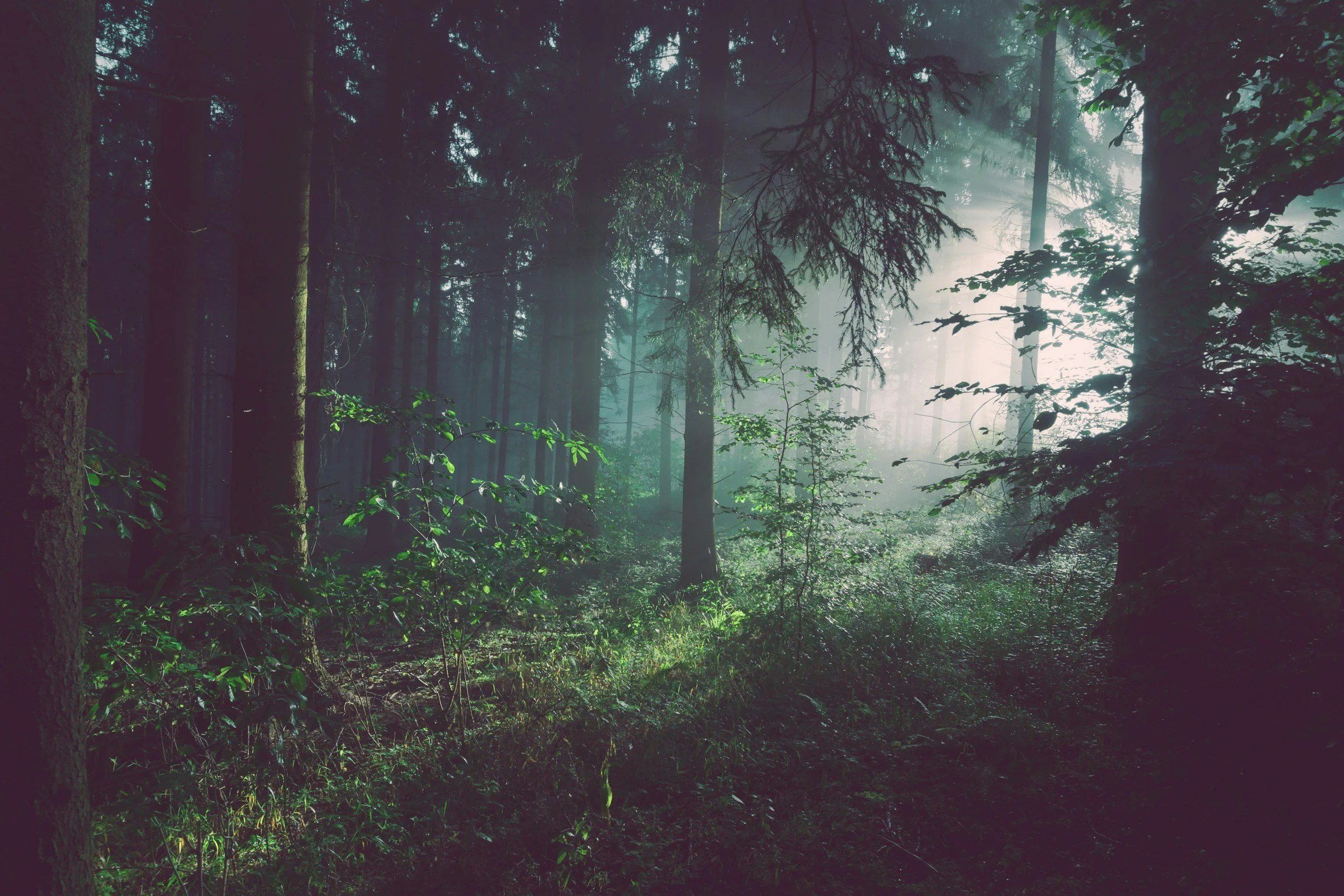
communion
by luca ririnui
the forest listens.
its soil is porous, shaped with space for the soundscape it absorbs. silt grains resonate at different frequencies to the sweet rot of humus granules or the brittle clatter of pebble fragments, allowing the internalisation of any register. the resulting velvet hum is muffled by the leaf litter, emanating quietly enough from beneath the wet cellulose skin that one might not believe anything was being heard at all. a thin microbial film binds the rootbed together. it swells with echoes, softening their arrival before folding the noise into itself and swallowing it back into silence.
the aboveground drinks sonance too. webs of crevices carved into bark allow the passage of Earth’s song through ever-divergent paths. sounds linger there, tracing growth rings to stay close to the evergreen warmth. if an undertone is light enough, it can ride spore currents seeping from fissures in the wood, diffusing far from its point of utterance. the forest will take it where it is needed. updrafts lift spores above canopy foliage to listen beyond the grasp of the trees. theirs is a gentle vigilance, for it is rare that they hear anything truly worrisome.
the forest sings.
it doesn’t care who’s listening. the morning chorus of cicadas and bullfrogs trills and thrums in sun-warmed reverence for the promise of each new dawn. their calls bounce off the wingbeats of hummingbirds, of damselflies and moths, and transpose into new keys as they radiate through the thick air. the vibrations stir the beetles into routine, clicking their shells into alertness, and coax the foxes’ cries. even the breeze dances in tune, whistling through branches and thicket to harmonise with the birdsong. the music is older than all that give it voice.
sometimes, the forest speaks.
roots stretch for miles between wooden elders. they clasp onto fungal hyphae in mutual dependence. the mycorrhiza branches into a vast underground network, and the trees speak through it. the pulse of sugar flowing to deprived phloem is laced with ancient messages of support. fungi mediate whispered negotiations over shade amongst neighbours and coordinate flowering across acres of woodland. when under threat, trees send defence hormones through the ground to ask for aid and warn their kin, flaring up anything alive in their vicinity. it is unclear how extensive these networks are, how much they can say. the earth tingles with syntax all the same.
a particular talking point of late is the discordant ones. they are lanky and clumsy. loud. the drone of their crude machines pervades the bluebell clearings and throws off the tūīs’ lilt. and they have a funny way of seeing things. with their flagpoles and contracts and borders, they seem to think that they can own the life they walk among. but these creatures are no gods. they either cannot hear the forest’s melody or shout over it in spite, desperate to usurp the choir. both prospects are unsettling to the forest.
the trees have reached consensus. the discordant ones will not integrate.
their sawdust falls like snow, confusing the spores. roots tense, bracing themselves as chemicals leach down their soil. they reek of arrogance. terra nullius, they say, ‘land belonging to no one,’ before they assert themselves where they please. what of the land’s sovereignty? they seem not to even recognise their own kind, displacing those in tune with the forest’s song to legitimize their legal fiction. there is a burnt acridity in the air, and the worms burrow deeper to avoid its taste.
the forest speaks less nowadays.
partially because there is less to discuss. partially because the fungi have turned their energy towards expansion. the corpses of the discordant ones provide a greater nutrient supply than usual, allowing growth into the metallic terrain they once played on. soon, the vines and mosses that have pulled most of their cities to the ground will hear the forest’s whispers again, carried through the moist networks that lie below. the trees conduct their orchestra as ever. the cicadas never knew there was reason to halt their song.
Gorzelak, M. A., Asay, A. K., Pickles, B. J., & Simard, S. W. (2015). Inter-plant communication through mycorrhizal networks mediates complex adaptive behaviour in plant communities. AoB PLANTS, 7, plv050. https://doi.org/10.1093/aobpla/plv050